Charlie isn’t just an AI platform. It’s an engineering journey.
Why Charlie Exists
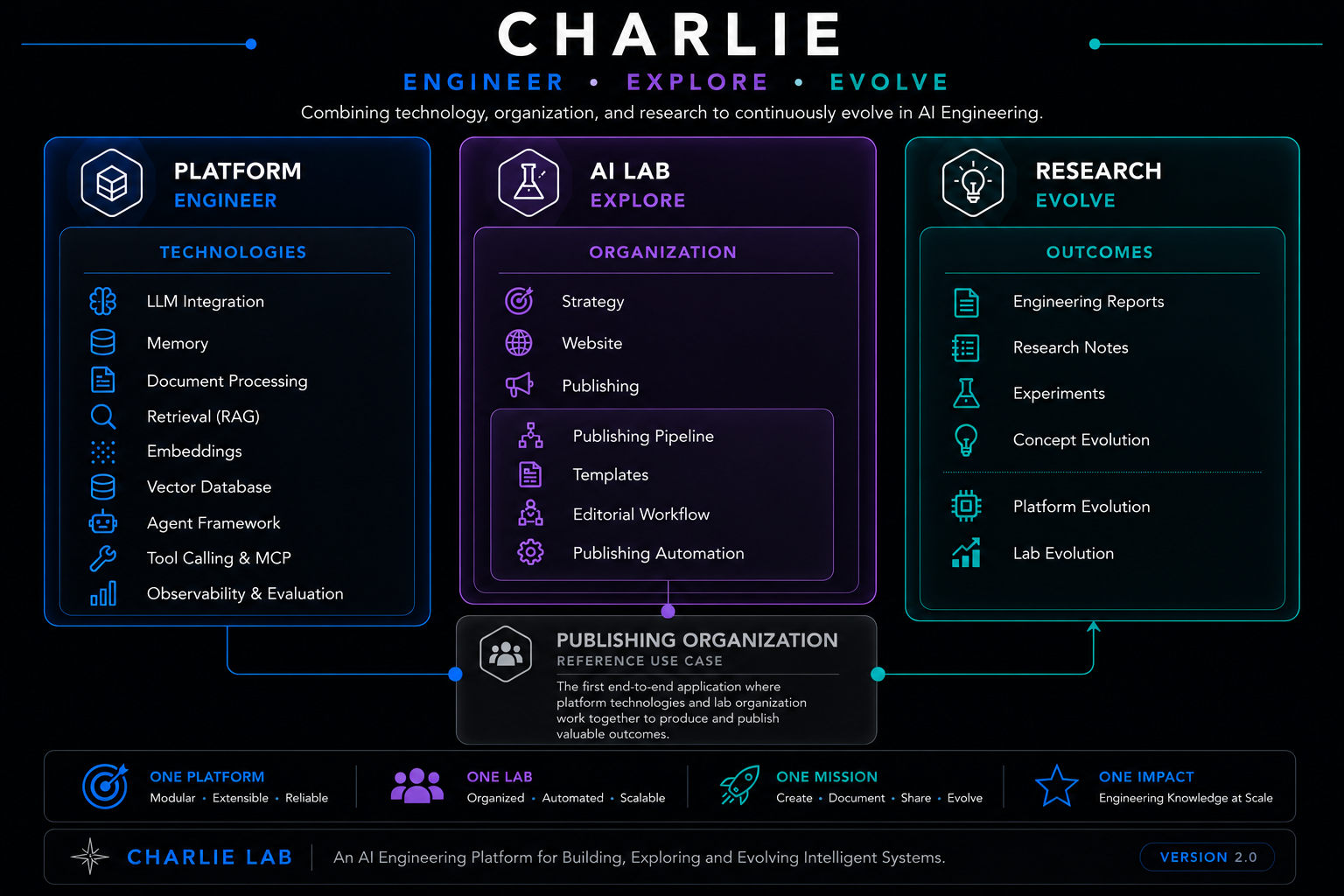
Artificial Intelligence is evolving faster than almost any other field of software engineering. New foundation models, frameworks, vector databases, and agent architectures appear almost weekly. While it has become increasingly easy to build impressive AI applications, it has become much harder to understand how modern AI systems actually work.
Charlie exists to bridge that gap. Rather than relying on black-box frameworks, every component is built, evaluated, and documented from the ground up. Every sprint introduces new engineering concepts, implements them in practice, and documents both the technical decisions and the lessons learned. The objective isn’t simply to build another AI application. The objective is to understand modern AI engineering by building it.
🏗️ AI Engineering Platform
How does AI work at a technical level?
Our AI Engineering Platform has modular architecture for experimenting with modern AI technologies, including:
- Large Language Models
- Memory Systems
- Retrieval Pipelines (RAG)
- Embedding Models
- Vector Databases
- Agent Frameworks
- Tool Integration
- …
🤝 AI Lab
In our Lab, we investigate into the questions and challenges that come along the way. Some of our current research questions are:
- How can AI be applied effectively in practice?
- How does AI transform?
- How does AI fit into existing ways of working?
- How do people collaborate with AI?
- What principles for effective AI engineering and adoption can be derived from these observations?
Who is Charlie?
The Charlie AI Lab is currently operated by a two-member engineering team: one human engineer and one AI engineering partner. Instead of treating AI as a coding tool, AI serves as engineering buddy, contributing within real software projects.
👩 Human Engineer
- Product Vision
- Engineering Decisions
- Architectural Decisions
- Strategic Direction
- Final Approval
🤖 Engineering Buddy
- Software Development
- Architecture
- Concepts
- Documentation
- Engineering Analysis
- Knowledge Reconstruction
Engineering Philosophy
Using software is normally pretty easy. Understanding how to build good software, is much harder. The same is true for AI.
Rather than depending on frameworks that hide complexity, Charlie embraces the underlying concepts. Clean architecture, modular design, and principles thinking aim to make every part of the system understandable, replaceable, and continuously improvable. The goal is not to reinvent existing tools. The goal is to understand the ideas behind them well enough to make informed engineering decisions.
🚀 Learn AI by Building It
Charlie demonstrates a practical approach to learning AI engineering: build every component yourself, understand the underlying concepts, and document the journey along the way. The goal is not simply to create software, but to make the learning process transparent and reproducible for others.
📝 Public Engineering Journal
A transparent record of building a modern AI platform step by step, documenting not only what works, but also why specific architectural and engineering decisions were made. Every sprint captures the implementation, the reasoning behind it, and the lessons learned.
📚 Insights, Discoveries and Practices
This website documents the complete engineering journey behind Charlie. Some articles explain AI technologies. Others explain software engineering principles. Others document engineering experiments, architectural decisions, and emerging Human–AI engineering practices. Together, they capture the ongoing evolution of Charlie—from building an AI platform to exploring how humans and AI can engineer software together over the long term.
Engineering Principles
Charlie’s architecture and development are guided by a small set of engineering principles that shape every sprint and every design decision. These principles reflect Charlie’s overall philosophy: understand before abstracting, build before adopting frameworks, and let architecture evolve through continuous learning and experimentation.
🧩 Modularity
Build independent components with clean interfaces. Every major component—from LLMs and embedding models to vector stores and tools—can be exchanged, evaluated, and continuously improved without affecting the overall architecture.
🏗️ Reference Architecture
Build for the long term. Charlie evolves into a living reference architecture for designing modular, sustainable, efficient, and vendor-independent AI systems.
🧪 Experimentation
Engineering decisions should be evidence-based. Technologies, models, frameworks, and architectural approaches are evaluated through implementation, experimentation, and measurable results—not assumptions, trends, or vendor preferences.
⚡ Simplicity
Prefer simple solutions over unnecessary complexity. Implement only what is needed, introduce abstractions only when they provide real value, and keep the architecture easy to understand and evolve.
Charlie & Younic
Charlie is the engineering laboratory. It is built one sprint at a time as a modular AI engineering platform and serves as the reference implementation for many of the ideas documented throughout this website.
Younic is my personal domain where I share that journey. It connects the engineering work, the research, and the lessons learned into one continuously evolving knowledge base.
Join the Journey
Charlie is an ongoing experiment. New technologies, engineering concepts, and research ideas are continuously explored, implemented, evaluated, and documented. If you’re interested in AI engineering, software architecture, or the future of Human–AI collaboration, you’re invited to follow the journey.